The Sargassum Barriers Are Working, Up to a Point
By Karla & Max · · Travel Planning
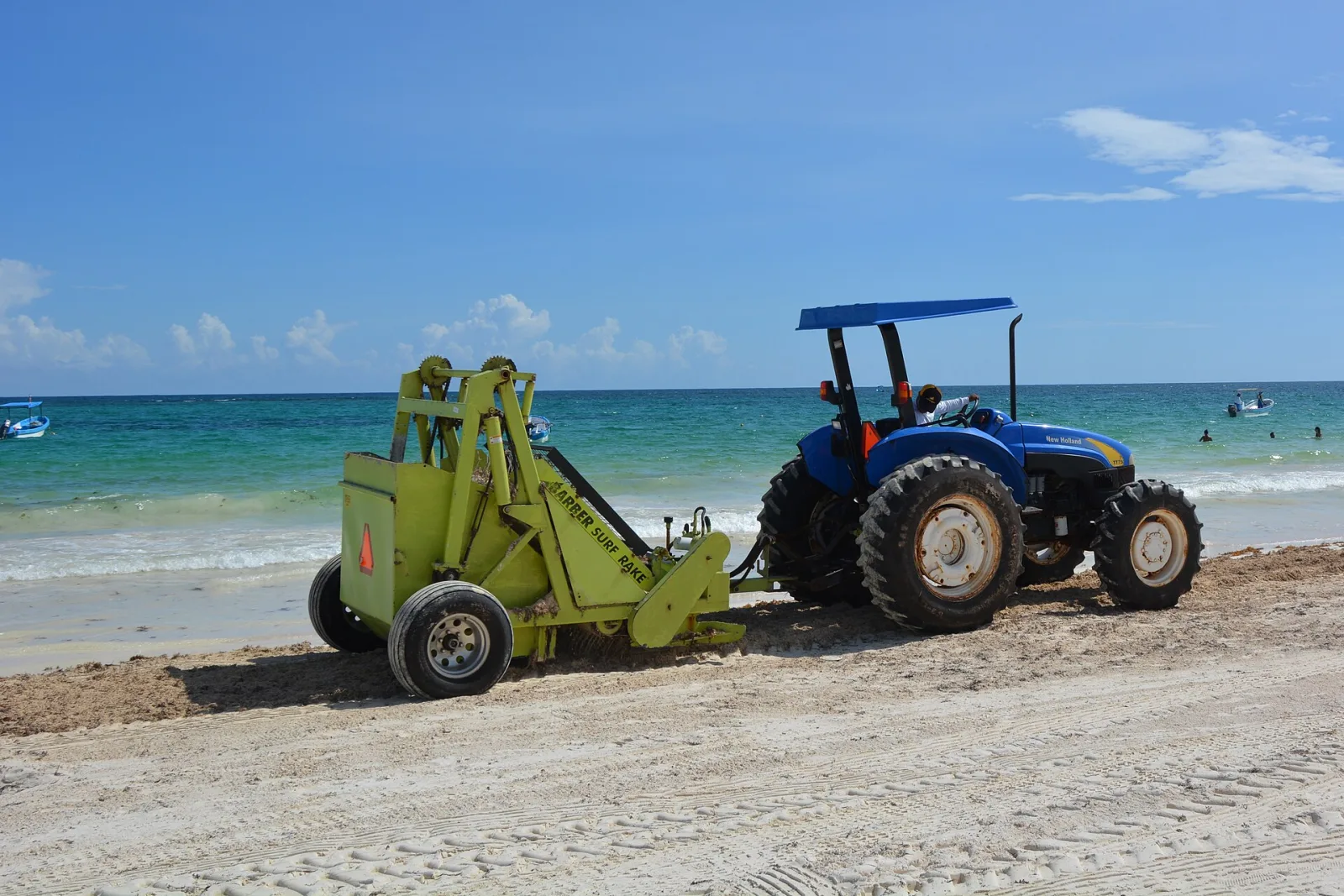
A mile and a half of floating barrier now sits offshore at Playa Paraiso, and two collection boats work the water behind it. A long-time Tulum resident who went down to the beach in late August, after weeks away, described the difference as large: almost nothing on the sand, though the water still had pieces in it.
Someone else, watching the same public beach camera a few days later, saw a tractor and trailer being loaded with a great deal of seaweed and called it an uphill battle.
Both of them are telling the truth. This is an attempt to explain how that can be, using the numbers the state actually publishes and the science that is actually settled — and the parts that are not.
The Record, in Numbers
Quintana Roo's environment ministry, SEMA, reported on 11 September that 124,852 tonnes of sargassum had been pulled off the state's coast between April and August 2026. That is 29,069 tonnes more than the same five months last year.
The macroalga affects 1,176 kilometres of beach in the state. The season officially runs 1 April to 30 October, though arrivals now happen in some form all year.
Here is the part that surprises most people, including us. The municipal breakdown, in tonnes extracted:
- Playa del Carmen — 42,063 - Cancun — 29,899 - Puerto Morelos — 17,111 - Tulum — 16,471 - Othon P. Blanco (Mahahual, Chetumal) — 14,013 - Isla Mujeres — 3,877 - Cozumel — 1,375 - Lazaro Cardenas — 39
Tulum is fourth. Playa del Carmen collected roughly two and a half times as much.
We should be honest that we have repeated the opposite in earlier posts, and so has most of the travel press: that Tulum sits on the most exposed stretch and takes the worst of it. The state's own figures do not support that.
They also do not straightforwardly prove the reverse, and this is worth understanding rather than glossing. Tonnes extracted is not the same as tonnes arrived. Playa del Carmen has a dense, hotel-lined municipal beach with machinery and crews working it daily. A large part of Tulum's beach sits inside a national park where mechanised cleaning is limited and some stretches are barely cleaned at all. Seaweed that is never collected never enters the statistic.
What the numbers do prove is that the cleanup effort in Tulum is smaller, not that the sargassum is. Which, for a visitor standing on the sand, produces much the same feeling.
Who Put the Barriers There
The barriers are not a hotel initiative. They are federal.
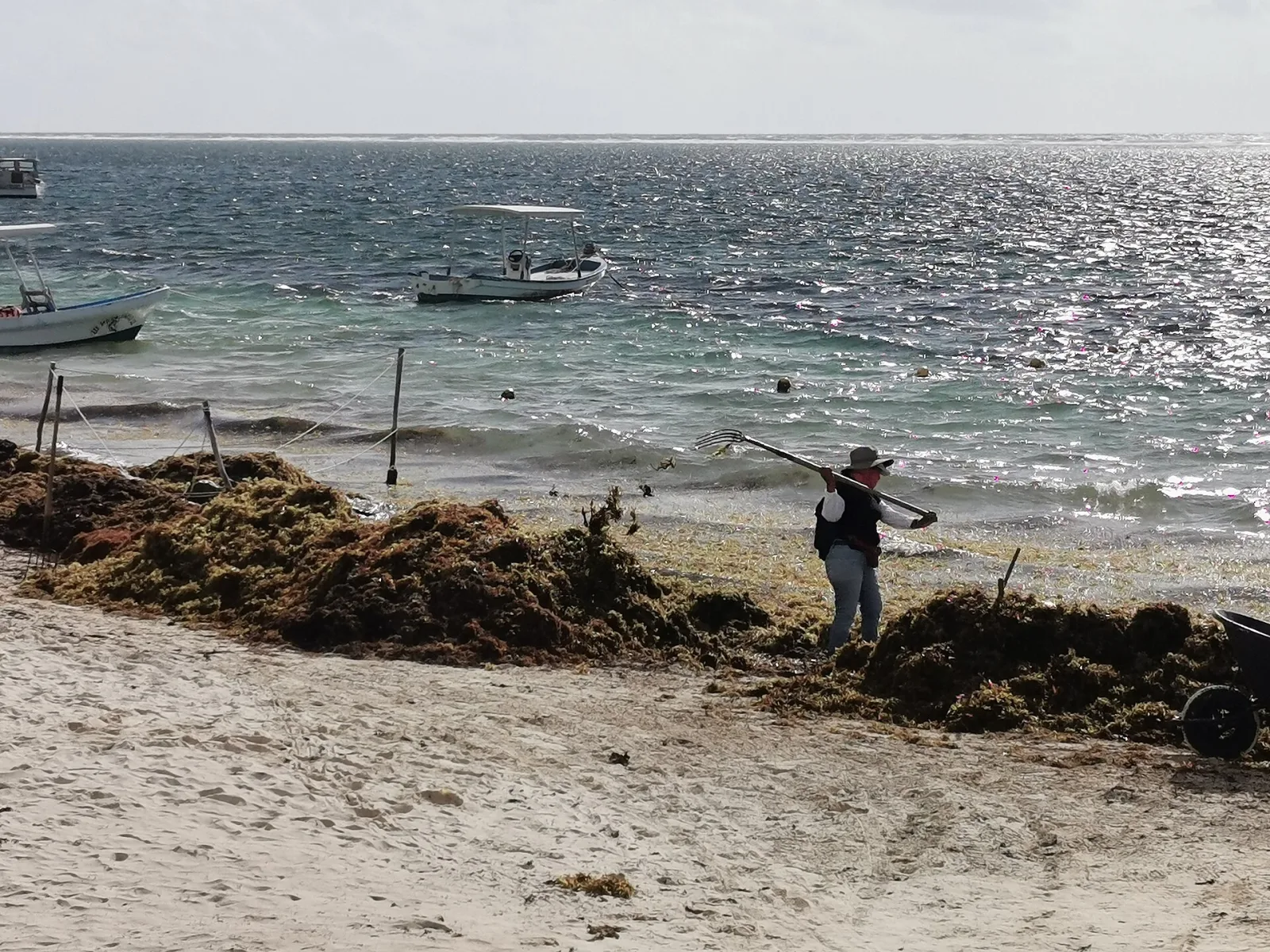
Under the National Sargassum Strategy 2026, the Mexican Navy, SEMAR, has installed 12,855 metres of containment barrier at what it calls specific and strategic points along the Quintana Roo coast, and expects to reach 16,030 metres. SEMAR itself collected 52,988 of this season's tonnes; the state government and municipalities accounted for the other 71,864.
Thirteen kilometres of barrier against 1,176 kilometres of affected coastline is roughly one percent. That is the correct way to hold the Playa Paraiso improvement in your head: it is real, it is local, and it is a rounding error at the scale of the problem.
Why It Will Not Simply Be Fixed
This is the part most travel guides skip, and it is the part that tells you what to expect for the next few years.
The Great Atlantic Sargassum Belt did not exist before 2011. It now stretches more than 8,000 kilometres, from West Africa to the Gulf of Mexico. At its recorded peak in June 2022 it covered roughly 6,989 square kilometres, an estimated 23.3 million tonnes of wet biomass.
For years the leading explanation was fertiliser running off farmland into the Amazon, the Orinoco, the Congo or the Mississippi. That explanation is now in serious doubt.
A study led by Julien Jouanno, a physical oceanographer at the University of Toulouse, published in Nature Communications in 2025 with colleagues at the University of South Florida, Sorbonne University and Mexico's own CICESE research centre in Ensenada, used ocean models to test the competing theories. It found something different.
Two consecutive years of a strongly negative North Atlantic Oscillation in 2009 and 2010 — a shift in atmospheric pressure that changes Atlantic wind and current patterns — swept patches of sargassum out of the Sargasso Sea, towards Europe, then south, and finally into the tropical Atlantic. There they found warmth, sunlight and nutrients all year round, and established a self-sustaining population that had never been there before.
The nutrients, the model found, do not come from rivers. They come from vertical mixing: seasonal winds dragging deeper, nutrient-rich water up into the sunlit surface layer where the algae grow.
"We had posed the hypothesis before that it is not the rivers that feed the formation of the Sargassum blooms in the tropical Atlantic," said Frank Muller-Karger of the USF College of Marine Science, a co-author. "This model supports that nutrients from slightly deeper layers in the ocean feed the blooms."
Jouanno was careful about what this does and does not establish. "At this stage, we cannot say for certain whether this abnormal event is a direct result of climate change," he said.
Two consequences follow for anyone planning a trip.
First, nobody is going to switch this off. If the driver were a river, you could in principle regulate the farms upstream. An ocean circulation regime that has already shifted is not something a government can legislate away.
Second, it is becoming less seasonal. At the UN Ocean Conference in June 2025, Dominican Republic president Luis Abinader told world leaders that sargassum had stopped being a seasonal event and become a continuous threat, and asked for a coordinated international response. The tourism industry in the Mexican Caribbean says the same thing more quietly.
How to Check the Beach Yourself
This is the practical part, it costs nothing, and it beats every guide including this one. Conditions change week to week and beach to beach. A photograph taken in February tells you nothing about tomorrow.
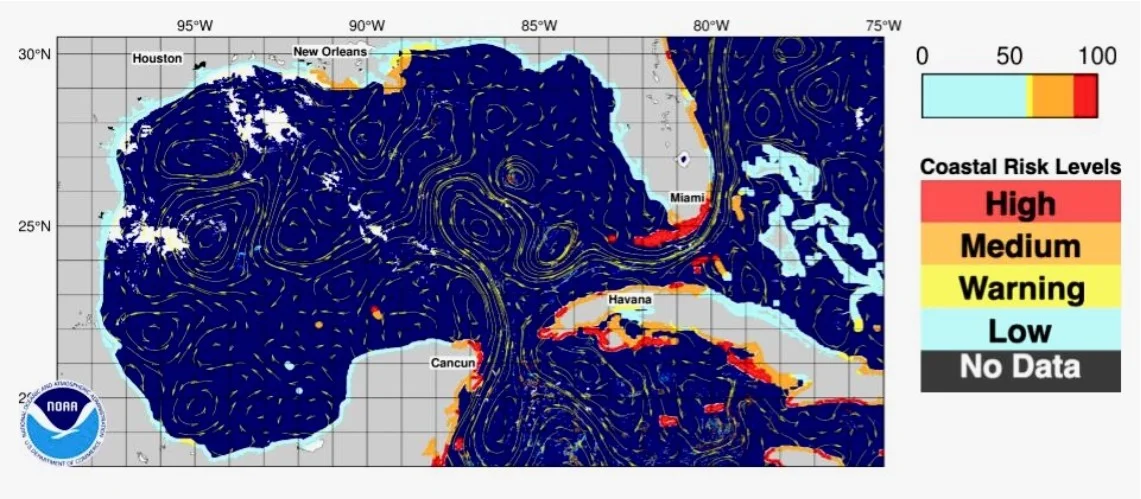
- Public beach cameras. Several hotels stream their own sand. Casa Malca runs one on its website looking out over the hotel zone. A live camera does not flatter anybody, which is exactly why it is useful. - Instagram accounts that post daily. The account tulumbeachdiaries posts stories from different parts of the beach most days. Hotels do the same, though naturally on the good days: Kai Tulum and El Paraiso both post their beach. - NOAA's inundation risk reports for the wider Caribbean, if you want the regional picture rather than one stretch of sand. - Traveller forums. People post photographs of the actual beach on the actual day. Unpolished, and the most reliable source there is.
If you are flying, check about a week out and again two days before. If you are driving down from Merida, Cancun or Playa, check the morning you leave. Anything older is history, not forecast.
Getting Onto the Protected Stretch
The barriers sit along Playa Paraiso, so the sand in front of the Parque del Jaguar section is the part most likely to be clear.
Two notes from residents, both current rather than guaranteed, because beach clubs revise their rules constantly. Several hotels along the park issue free day passes through their own websites; Ikal Tulum has been running an on-demand form that people report works — fill it in, show it at the gate. Kai Tulum has been letting visitors park a scooter without demanding a minimum spend, and its beach sits behind the barriers. El Paraiso charges for sun beds and does ask for a minimum.
Since the federal decree of 20 July 2026 you can also walk into the national park and reach the sand without paying the archaeological zone fee. Mexican nationals pay nothing for the park, and nothing at all on Sundays.
What This Means If You Are Booking
September and October are the last of the low season. Rates are at their lowest, the town is genuinely quiet, the cenotes have no queues, and the beach is a gamble that the barriers have shortened without settling. The official season ends 30 October. The winds that usually clear this coast turn around December and January, and roughly November to April has historically been the dependable window — residents who have been here for decades will tell you last winter had weeks of genuinely beautiful water.
They will also tell you that "historically" is doing more work in that sentence every year.
So: if a swimmable ocean every day is the entire point of the trip, come between November and April, pay the winter price, and check the cameras anyway. If the ocean is one of several reasons you are coming, this is an unusually cheap window in a town that has emptied out — and the freshwater is completely unaffected by any of it. The cenotes sit at twenty-four degrees all year and no sargassum has ever reached one.
The barriers are a real improvement on one stretch of beach. They are not a solved problem, and anyone telling you otherwise is selling you something.
Sources
- Secretaria de Medio Ambiente de Quintana Roo (SEMA), collection figures April–August 2026, reported by Noticaribe, 11 September 2026. - Secretaria de Marina (SEMAR), National Sargassum Strategy 2026, barrier deployment figures. - Jouanno, J. et al., Nature Communications, 2025 — North Atlantic Oscillation and the origin of the Great Atlantic Sargassum Belt. Summarised by the University of South Florida College of Marine Science. - Mongabay, June 2025, on the study dismissing Amazon river runoff as the primary driver. - Statement by President Luis Abinader, UN Ocean Conference, June 2025. - First-hand beach reports from Tulum residents on r/tulum, August–September 2026.